
In Focus
Sonia Camapagnola & Brent Foster Jones
Edition 1
Apr 2026
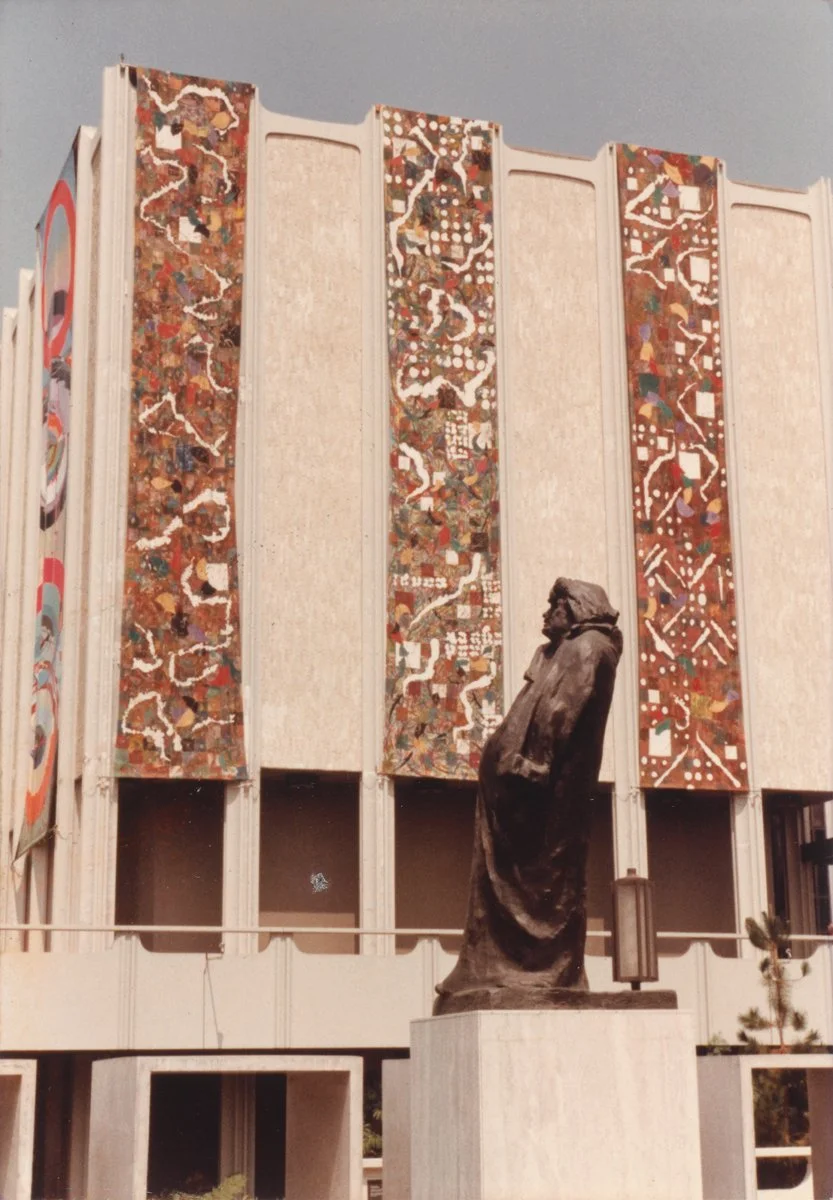
Between (1981): Confronting It
“The vigorous columnation that rises over sixty feet and repeats itself across the vast concrete expanses of the Museum could have been an impediment . . . McCafferty chose to confront it.”¹
—Stephanie Barron
Senior Curator and Department Head of Modern Art, Los Angeles County Museum of Art
In the early 1970s, Jay McCafferty (1948–2021) began creating controlled burn marks on paper that revealed halos of intense, glowing hues. The resulting buoyant works, rich in texture, possessed a distinct tactile quality. In 1980, Los Angeles art critic Christopher Knight enthused in Artforum that “the sensual, exuberant colors—vivid yellows, purples, oranges . . . reveal the artist to be quite happily in control of his circumstances.”² The following year McCafferty expanded his practice and challenged himself to work on an unprecedented scale and on a new surface: canvas. Between (1981) was the artist’s most ambitious work—a brightly colored, epically scaled site-specific solar burn triptych installed at the Los Angeles County Museum of Art.
Highly regarded in the Los Angeles art scene, having won the LACMA New Talent Award in 1974 and fresh off a dazzling Artforum review, in 1981 McCafferty was invited by newly hired Curator of Modern Art Stephanie Barron to participate in the exhibition “The Museum as Site: Sixteen Projects.” Organized on the occasion of the Los Angeles’ Bicentennial, the display of site-related and installation art included experimental works by artists such as Michael Asher (1943–2012), John Baldesseri (1931–2020), Chris Burden (1946–2015), Eric Orr (1938–1998), and Alexis Smith (1949–2024) and ran concurrently to “Seventeen Artists in the Sixties,” organized by Senior Curator of Modern Art Maurice Tuchman with works by David Hockney (b. 1937), Robert Irwin (1928–2023), Larry Bell (b. 1939), and others.
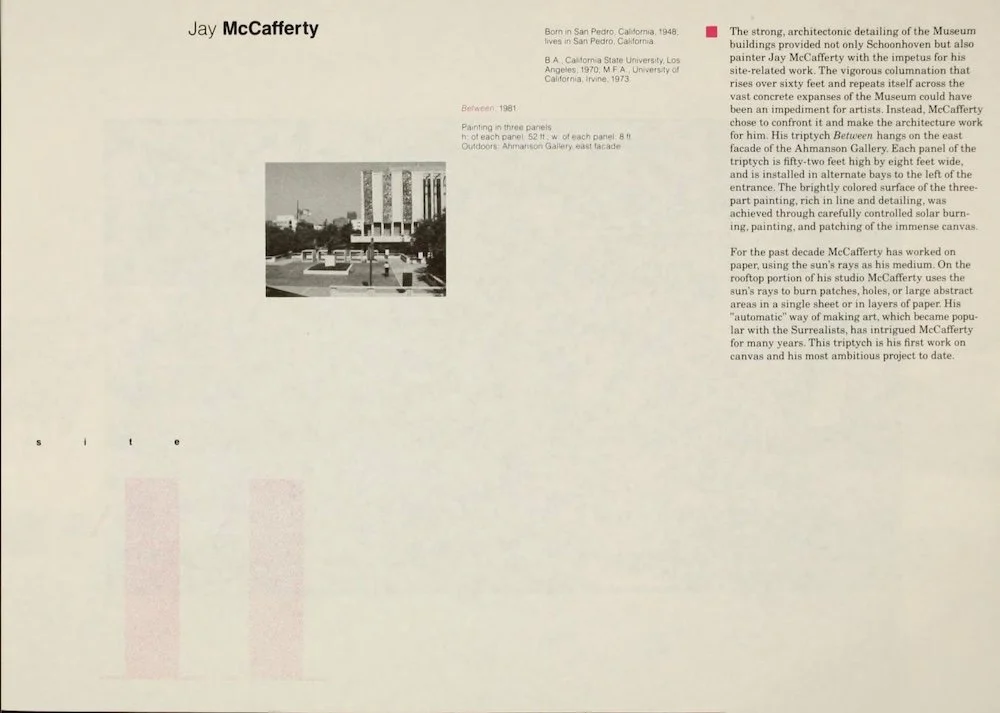
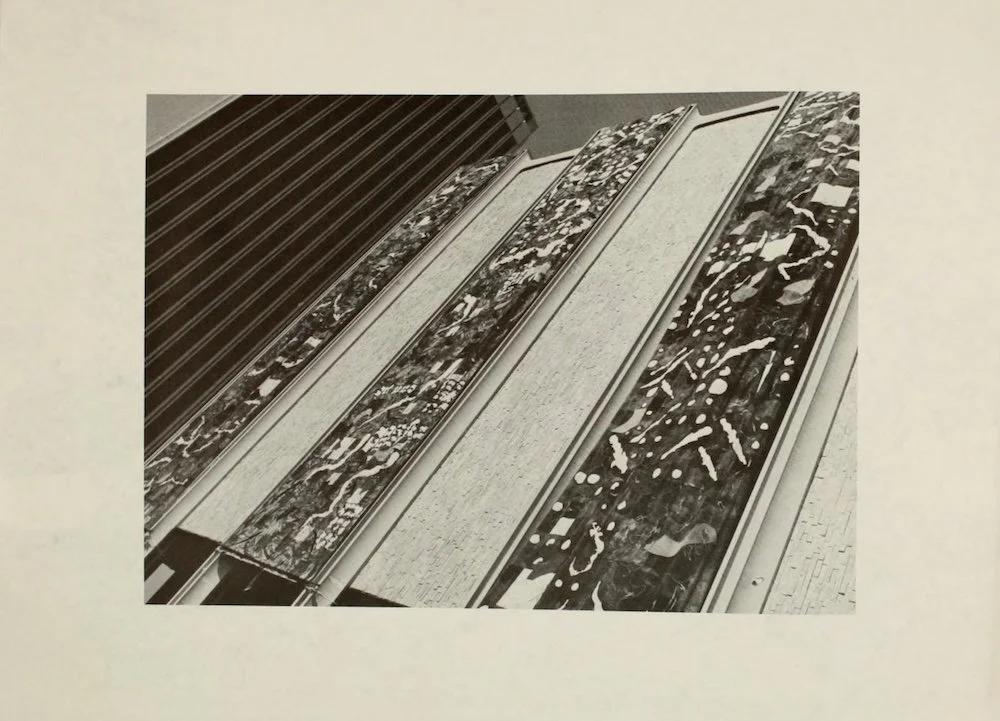
In response to the museum architecture’s striking New Formalist rows of concrete columns, McCafferty burned, painted, and patched canvas in monumental dimensions, producing Between, a site-specific work consisting of three, vertical banners. Each banner measured fifty-two feet high and eight feet wide and was suspended in alternate bays, cascading from the roof of the east façade of the now demolished Ahmanson Gallery.
In the exhibition catalogue, the elegant, formally rigorous black-and-white photographs of Between taken by Southern California artist Robbert Flick (b. 1938) document the moment when Between was unfurled by McCafferty and museum staff. In the text accompanying the pictures, Barron observed that “the vigorous columnation that rises over sixty feet and repeats itself across the vast concrete expanses of the Museum could have been an impediment . . . instead, McCafferty chose to confront it and make the architecture work for him.”³
“He was very excited and it was early in his career,” remembers Ellen McCafferty, the artist’s widow who today oversees the preservation and promotion of her husband’s work. “I remember Jay working on the roof [of their house in San Pedro] and how he had to work in sections. My memory is that he painted the whole canvas first and then burned it section by section.” She added that he would conduct tests of each individual painting that comprised Between, which he strengthened with additive strips of canvas, by rolling down a section a time off the side of the house.
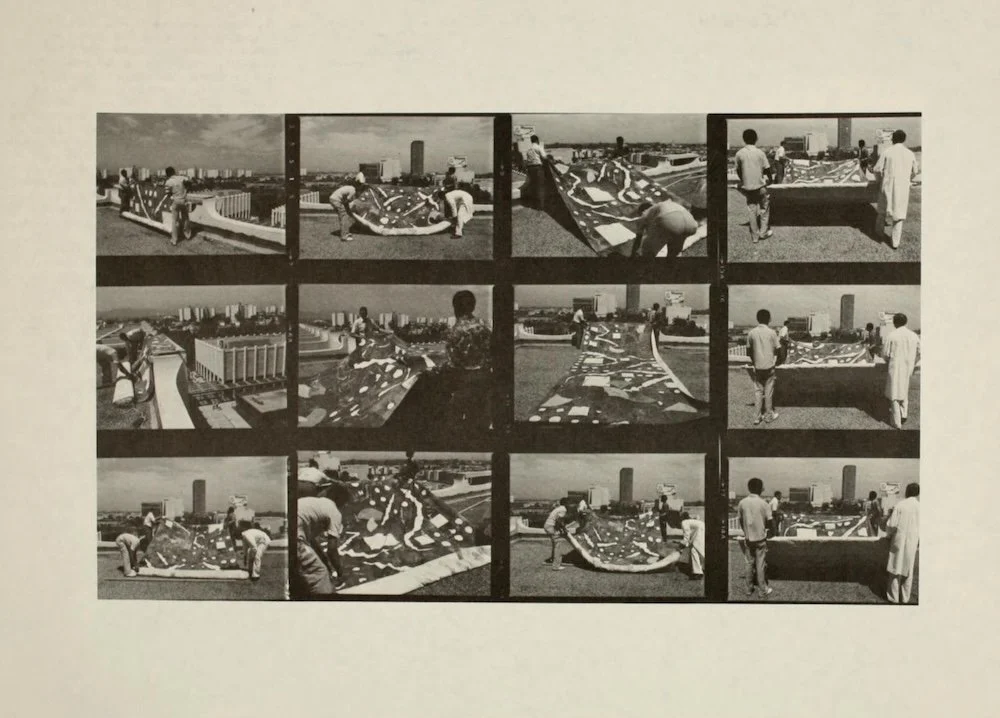
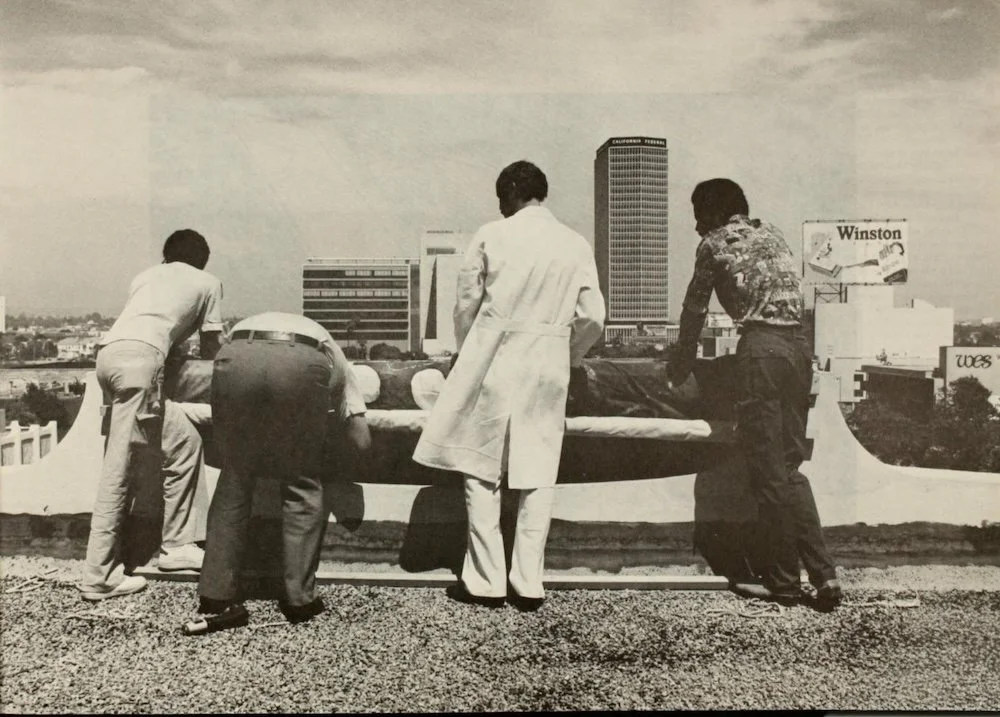
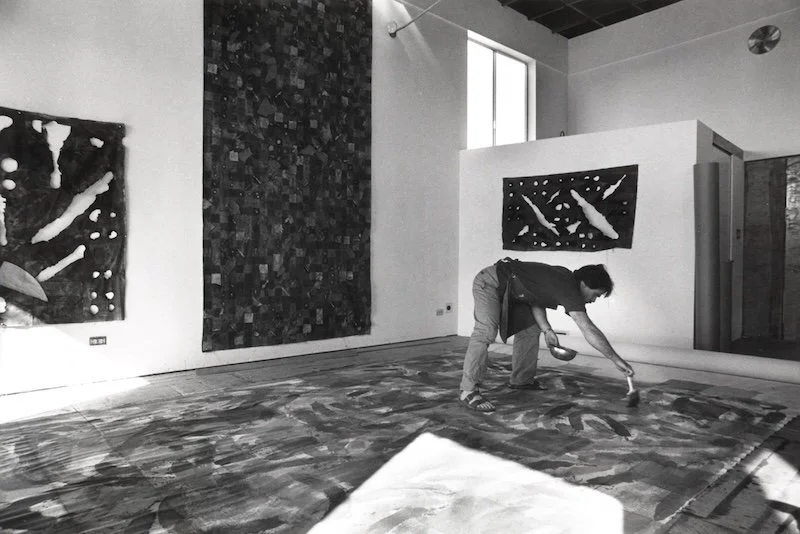
Jay McCafferty working on Between in his studio, ca. 1980.
Barron, in her text, added that “for the past decade McCafferty has worked on paper, using the sun's rays as his medium … his ‘automatic’ way of making art, which became popular with the Surrealists, has intrigued McCafferty for many years.” In fact, the artist began burning holes into materials at the beginning of the 1970s. From the outset, fire was not simply a tool but a primary medium. Initially he mostly burned paper—sometimes pigmented, sometimes plain, following a grid or freely guided by instinct. Over time though, he extended this practice to other materials, including wood and cardboard, testing how the burns would behave across different surfaces and densities.
While the physical act of painting and burning canvas was technically similar to the process on paper or cardboard, McCafferty recognized that the perceptual effect on a large scale would be fundamentally different from the small scale he was used to. In the smaller size, his solar burn paintings invoked an absorbing, meditative effect as the surface revealed the details of the charred edges, the tonal shifts, and the halos of smoke around each perforation. But Between, with its color variations and textures interacting across large expanses, was less about intimacy and more about the viewer’s engagement with the surrounding space, light, and the relationship between architecture and art.
“Jay McCafferty’s three banners … with their loose grids of scimitar shapes on orange-and-gold grounds, recalled patined ceramic in their color and patterning … ”
—Howard Singerman, Artforum
American art historian and curator Howard Singerman, writing in a review of the exhibition for Artforum in March 1982, argued that “some artists not usually associated with site-specific work did try to meet the demands of the title, and suffered in the attempt.” But, he pointed out, “Jay McCafferty’s three banners, on the other hand, with their loose grids of scimitar shapes on orange-and-gold grounds, recalled patined ceramic in their color and patterning—an architectural reference which helped them fit their situation and enabled them to fare somewhat better.”⁴
Although he never produced a painting at this size again, McCafferty continued to explore canvas, and his paintings gradually grew larger. In 1994, he debuted a new body of large-scale works atMark Moore Gallery in Santa Monica, California featuring a distinctive horizontal composition marked by rows of burned holes and bands of painted color.
Jay McCafferty Estate has preserved and digitized for study the exhibition catalog, Art in Los Angeles: The Museum as Site—Sixteen Projects. It is also available online.
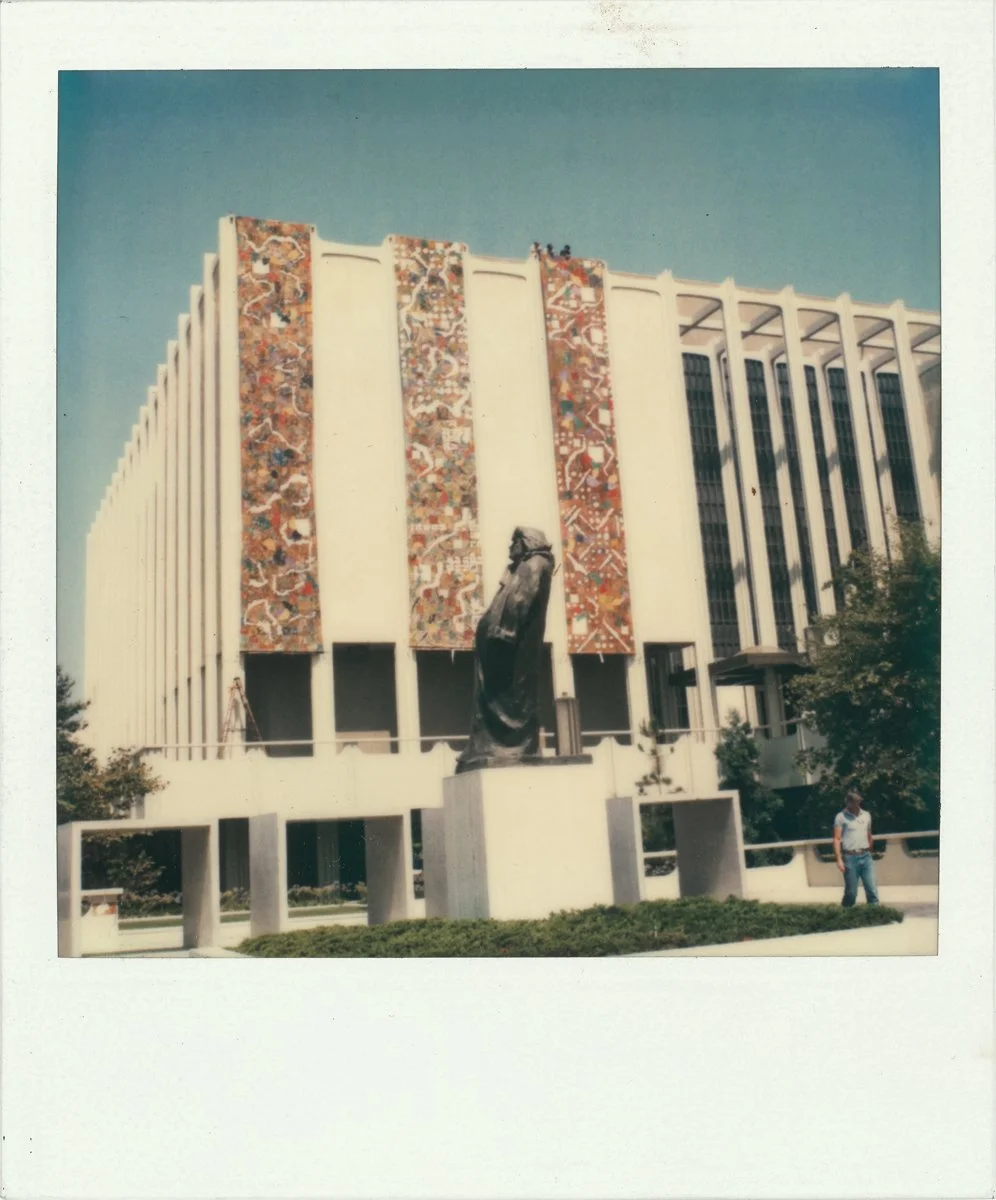
A Polaroid documenting Between (1981), a large-scale installation on the east façade of the former Ahmanson Gallery at LACMA.
-
¹ Stephanie Barron, Art in Los Angeles: The Museum as Site—Sixteen Projects (Los Angeles: Los Angeles County Museum of Art, 1981), exhibition catalog, 27.
² Christopher Knight, review, Artforum 18, no. 9 (May 1980): 85.
³ Stephanie Barron, Art in Los Angeles: The Museum as Site—Sixteen Projects (Los Angeles: Los Angeles County Museum of Art, 1981), exhibition catalog, 27.
⁴ Howard Singerman, Artforum, March 1982 (Vol 20. No. 7):